Next-Generation Waveforms
Status: Past (2024.03 - 2026.02)
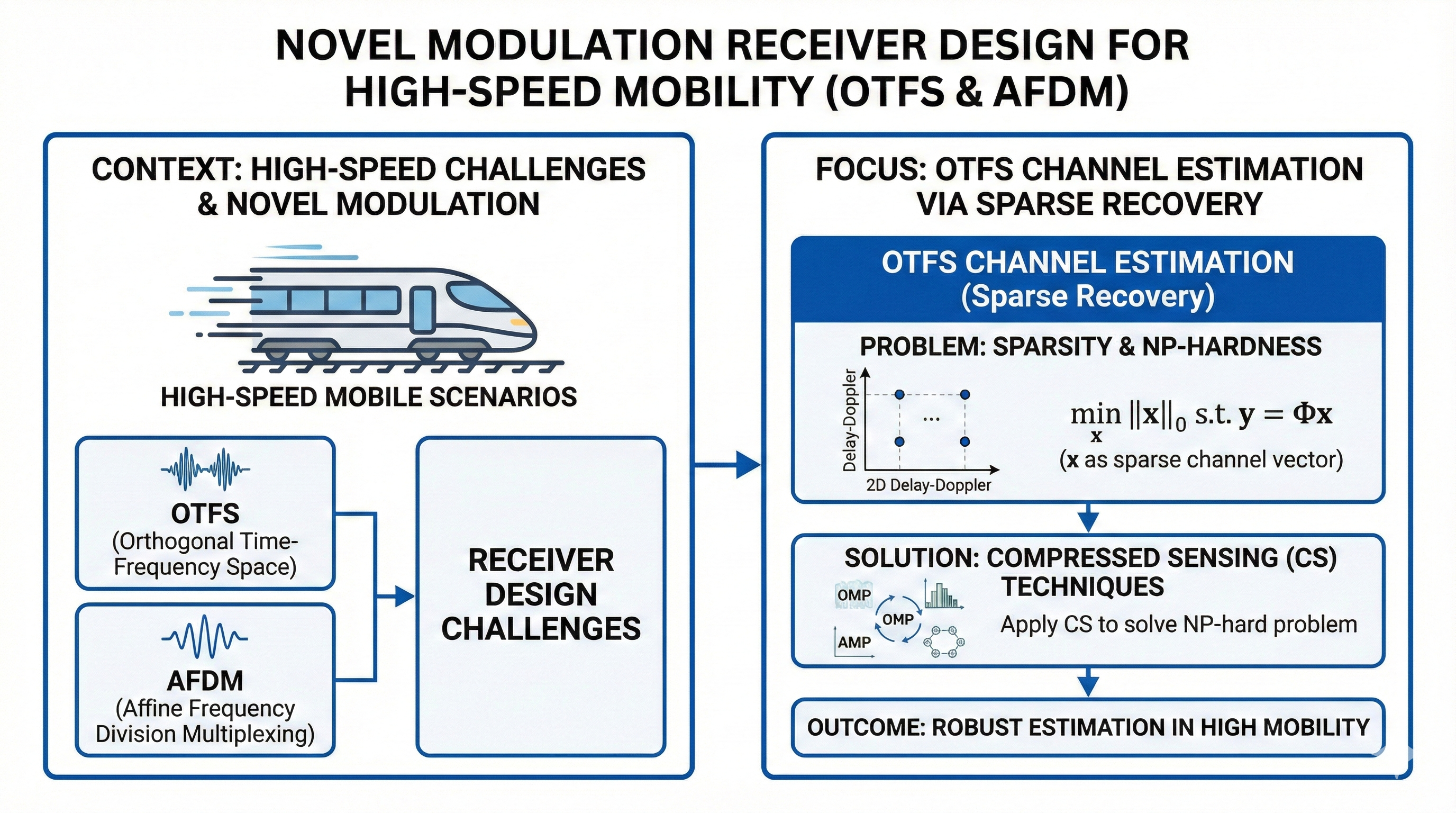
These researches focus on channel estimation and detection algorithm design for emerging modulation techniques such as orthogonal time-frequency space (OTFS) and affine frequency division multiplexing (AFDM), particularly in high-mobility scenarios. My work primarily focuses on OTFS.
Why OTFS?
Compared to OFDM, which operates directly in the time-frequency domain, the primary motivation for OTFS is that in high-mobility scenarios, OFDM is susceptible to inter-carrier interference caused by the Doppler effect, while propagation path parameters in the DD domain typically vary more slowly and possess clearer physical significance.
There are other perspectives as well. For instance, Professor Ronny Hadani (the proposer of OTFS) cited the desire to preserve mathematical rotational invariance, while Professor Weijie Yuan noted in a blog post that this modulation scheme can reduce the number of parameters needed to describe the channel. In my view, these all stem from the same underlying reason.
System Model
A typical doubly-selective channel can be represented as $$h(\tau, \nu) = \sum_{i=1}^{P} \alpha_i \delta(\tau - \tau_i) \delta(\nu - \nu_i),$$ where \(P\) is the number of effective propagation paths, and \(h_i\), \(\tau_i\), and \(\nu_i\) are the complex gain, time delay, and Doppler shift of the \(i\)-th path, respectively.
My research focuses on channel estimation in the integer Doppler scenario. Assume that one OTFS frame contains \(N\) time slots, the length of each time slot is \(T\), and the total observation time is \(NT\). Then, the resolution in the Doppler domain is \(\Delta \nu = \frac{1}{NT}\). If the Doppler shift of the \(i\)-th path is \(\nu_i = \frac{k_i}{NT}\), where \(k_i \in \mathbb{Z}\) , then we say that the channel is in the integer Doppler scenario.
In addition, we have to mention about bi-orthogonal transeive pulse shaping. The bi-orthogonal pulse shaping can be expressed as $$\int_{-\infty}^{\infty} g_{tx}(t) g_{rx}^*(t - nT) e^{-j2\pi m \Delta f t} dt = \delta(n) \delta(m),$$ where \(g_{tx}(t)\) and \(g_{rx}(t)\) are the transmit and receive pulse shaping functions, respectively, and \(\Delta f\) is the subcarrier spacing. This condition ensures that the transmitted symbols can be perfectly recovered at the receiver without inter-symbol interference (ISI) or inter-carrier interference (ICI).
Channel Estimation Problem Formulation
Vectorizing the received pilot region and the candidate channel support yields a linear inverse problem, which is typically underdetermined when the number of pilot observations is smaller than the channel dimension. $$\mathbf{y} = \mathbf{\Psi} \mathbf{h} + \mathbf{w},$$ where \(\mathbf{y}\) is the received pilot vector, \(\mathbf{\Psi}\) is the sensing matrix constructed from the known pilot symbols and the DD-domain input-output relationship, and \(\mathbf{w}\) is the noise vector. Only a small number of locations correspond to valid propagation paths. Therefore, the channel estimation problem can be formulated as a sparse signal recovery problem $$\min_{\mathbf{h}} \|\mathbf{h}\|_0 \quad \text{s.t.} \quad \|\mathbf{y} - \mathbf{\Psi} \mathbf{h}\|_2^2 < \epsilon,$$ where \(\epsilon\) is a small positive constant that accounts for noise and modeling errors. Directly minimizing the $\ell_0$ norm is NP-hard. Therefore, we employed various compressed sensing (CS) approaches.
Proposed Algorithms
While I am unsure if this qualifies as a contribution, my work focuses on how to estimate the channel when the channel sparsity (i.e., \(\|\mathbf{h}\|_0\)) is unknown.
- A Sparsity-Agnostic SL0 Channel Estimation Approach for OTFS Systems
- ADMM-Based Delay-Doppler Domain Channel Estimation for OTFS Systems
- Delay-Doppler Domain Channel Estimation for OTFS System Using the Gradient Projection Method
- Split Bregman Iteration-Based Channel Estimation for OTFS Systems
Useful Resources
-
Tutorials and Lectures
- [Chinese] Delay-Doppler Domain Communication Paradigm for 6G, by Professor Weijie Yuan
- [Chinese] OTFS-Tutorial, by Professor Zijun Gong
- [English] OTFS-Tutorial, by Professor Emanuele Viterbo
- [English] Zak-OTFS, by Professor Saif Khan Mohammed
- OTFS-sig I particularly recommend Professor Ronny Hadani's lectures.
-
Some Papers
- Orthogonal Time Frequency Space Modulation (nearly the first official research paper on OTFS)
- Orthogonal Time-Frequency Space Modulation: A Promising Next-Generation Waveform (awesome figures to help understand the concept)
- Channel Estimation for Orthogonal Time Frequency Space (OTFS) Massive MIMO
- Some Open Source Codes
- Codes
Note: I do not recommend any new graduate students to make it their main research direction, because OFDM has recently been designated as the 6G air interface waveform: [First 6G Agreement: OFDM confirmed: What it means?]